Is Your Rideshare Insurance Enough? TNC Gap Dangers
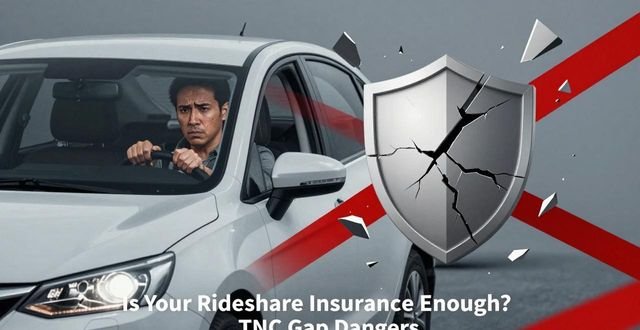
You think you’re covered. You pay your monthly premium, you keep the card in your glove box, and you tell yourself that if something bad happens, the insurance company will handle it. But then you sign into the app. You tap “Go Online.” And in that one second, everything changes.
Let me take you back a few years, before Uber and Lyft turned every car into a potential taxi. Back then, insurance was simple. You drove for personal reasons, you had personal insurance. You drove for work, you had commercial insurance. Two tidy boxes. Nothing in between.
Then the transportation network companies showed up. Suddenly, millions of ordinary people were driving their own cars, at strange hours, through unfamiliar neighborhoods, with strangers in the back seat. And the insurance industry? They just sat there, scratching their heads, for almost three entire years while drivers fell into a black hole of coverage.
Here’s what that black hole looks like.
Phase one: You turn on the app but haven’t accepted a ride yet. You’re cruising around, waiting for that ping. Your personal policy says, “No, we don’t cover any commercial activity.” And the TNC’s policy says, “Sorry, we only cover you from the moment you accept the ride until the passenger exits.” So who covers you in that gap? Nobody. Absolutely nobody. You are driving a two-ton metal box at fifty miles per hour with zero insurance. Zero.
Phase two: You accept the ride. Now the TNC’s contingent liability kicks in. But contingent means maybe. It means if your personal insurance denies the claim first. And your personal insurance will deny it, because you were logged into the app. So the TNC might pay, but only for damage you cause to others. Your own car? Your own medical bills? Your own broken ribs from that guy who ran a red light? That’s on you, my friend.
I talked to a driver in Austin last year. He had been doing rideshare for eighteen months. Never had a scratch. Then one Tuesday, two in the morning, a drunk driver smashed into his door. His leg shattered in three places. His car, a 2019 Camry he was still paying off, totaled. He had personal insurance through a major company. They canceled his policy the next day, said he violated the terms by driving commercially. The TNC’s insurance said his accident happened while he was offline? No, wait, he had just dropped off a passenger. So he was in period two? The app showed he had ended the previous ride three minutes before the crash. That put him back in the gap. The gap where nobody covers anything.
He lost the car. He lost six months of income. He lost his apartment because he couldn’t make rent. All because of a three-minute window.
That’s the thing about these gaps. They don’t care how careful you are. They don’t care that you’ve never had a ticket. They don’t care that you have three kids to feed. They just sit there, invisible, until something goes wrong, and then they swallow you whole.
You might say, “But I bought the rideshare endorsement from my personal carrier.” Good. That’s the first step. That endorsement usually covers period one, the gap when you’re waiting for a ride. But read the fine print. Really read it. Some endorsements have deductibles of two thousand dollars. Some exclude collision coverage entirely. Some only pay if you have comprehensive and collision on your personal policy first. And some? Some have a mileage limit. You drive more than forty hours a week? Congratulations, you just voided your own coverage.
Compare that to a proper TNC-specific policy from a company that actually understands this business. There are a handful now, not many, but they exist. They cover you from the second you go online to the second you go offline. They don’t play the contingent game. They don’t ask whether you were between rides or waiting for a ping. You’re either driving for the app or you’re not, and if you are, you’re covered. Simple.

But here’s the painful truth: most drivers never buy that policy. Why? Because it costs more. Maybe fifty, sixty, even a hundred dollars more per month than their old personal policy. And when you’re already counting every dollar, when gas prices jump and tips drop and the app takes its twenty-five percent, that extra hundred feels like a luxury. A luxury they can’t afford.
So they gamble. They tell themselves, “I’m a safe driver. The gap is only a few minutes. What are the odds?” And the odds? According to a study from the University of California, rideshare drivers are in periods one and two, the uncovered or undercovered periods, for about forty percent of their logged-in time. Forty percent. That’s not a tiny gap. That’s nearly half your shift. Imagine telling yourself that you only need a parachute for the first forty percent of your jump. You wouldn’t get on the plane.
The scary part is that most drivers don’t even know they’re gambling. They sign up for the app, they upload their personal insurance card, and the app says “Verified.” That feels like approval. That feels like safety. But the app doesn’t verify whether your policy covers rideshare. It just checks that the card isn’t expired. That’s it. A $50 billion company, and their safety check is a calendar.
So what do you do? First, call your insurance agent today. Not next week. Not when you have time. Today. Ask them one question: “Does my policy cover me from the moment I go online until the moment I go offline, with no gaps?” If they hesitate,if they say “well, it depends,” or if they start talking about contingent liability, hang up and find a new agent.
Second, look up the specific rideshare laws in your state. Some states, like California and New York, have forced insurance companies to offer TNC coverage. Other states? It’s the Wild West. You are your own sheriff.
Third, if you can’t afford full TNC coverage, at least buy the rideshare endorsement. It’s not perfect. It still has holes. But it plugs the biggest one, period one, the time when you’re cruising around waiting for that ping. That’s when most fender benders happen anyway. Distracted driving, looking at the app, checking your phone, boom.
And fourth, remember this number: 40 percent. Forty percent of your shift, you are not fully insured. Forty percent of the time, you are one bad decision from bankruptcy. Forty percent.
I’m not trying to scare you. Actually yes, I am. I am trying to scare you. Because scared drivers make phone calls. Scared drivers read their policies. Scared drivers ask hard questions. And scared drivers don’t end up like that guy in Austin, lying in a hospital bed with a shattered leg, watching his whole life fall apart because of a three minute gap.
You drive for the money. That’s honest. But if a single accident can wipe out everything you’ve earned, and everything you will earn for the next two years, are you really making money? Or are you just borrowing it from your future self, with interest compounding by the mile?
Go make that call. Now. Before you go online tomorrow. Before that next ping. Before that next red light runner changes everything.
You think you’re covered. Make sure.