Off the clock, off the coverage
Dear fellow driver, have you ever shut down your Uber or Lyft app, tossed the phone onto the passenger seat, and felt that sweet release of being “off duty”? I have. Hundreds of times. And for months, I never once questioned where my insurance went when that little green button turned gray.
Then came the Tuesday when my rear bumper met a light pole in a grocery store parking lot. App was off. Rideshare done for the day. I’d just picked up my dog from his vet checkup – a routine annual thing, nothing dramatic. As I backed out, crunch. My fault completely. No other car, just concrete and my own stupidity. I called my personal auto insurer, the one I’ve paid on time for seven years. “No problem,” I thought. “This is just personal driving. I wasn’t working.”
Never have I heard a claims adjuster laugh so politely before delivering the knife. “Your policy excludes any vehicle used for ridesharing. Even when the app is off? Correct. The exclusion is based on the vehicle’s primary usage classification you signed. You declared it for business – and business use, even during gaps, voids personal coverage.” Wait, what? But the app was off. I was just going home. My dog was in the back seat. How is this not personal errand?
Let me rewind and show you the trap. Every major rideshare company loves to talk about their insurance while you’re on a trip. Period 2 and Period 3 – that’s when you have a passenger or are en route to pick one up – yes, they provide liability and even contingent comprehensive. Period 1, however, that waiting time when the app is on but no ride accepted? That’s thin. But what about when the app is completely off? Zero. Nada. The company’s policy disappears the moment you sign out. And your personal auto insurer? Most standard policies have a rideshare exclusion buried on page fourteen,written in language that would make a lawyer yawn. They don’t care if the app was off for ten seconds or ten hours. Once they know you drive for a platform, many will deny any claim that doesn’t happen with the app actively on and the company’s own coverage primary.
So here’s the reverse logic that hurts: If you think turning off the app is a magic shield that restores your personal policy, think again. That’s like thinking removing the bullet from a gun makes it not a weapon. The insurance company does not check your app status at the moment of crash – they check your vehicle’s history, your declared occupation, and the endorsement you signed. I’ve seen drivers lose everything because they got rear-ended while driving to get coffee, app off, no passenger, but the other driver’s lawyer subpoenaed their Uber records. Suddenly, “personal errand” becomes “commercial gap period.” The judge doesn’t care about your caffeine craving.
How do you fix this before your own bumper meets a pole? You stop relying on the app’s on/off switch as your coverage boundary. That switch is a psychological comfort, not a legal one. Real solution: a rideshare endorsement added to your personal policy. Some insurers call it “Transportation Network Company coverage.” Others call it “Period 1 coverage.” What it actually does is fill the black hole – the time when your app is off but your car still smells like air freshener and last passenger’s perfume. With that endorsement, you’re covered in personal mode, waiting mode, and even the moments in between. No more guessing. No more “but the app was off” prayers.

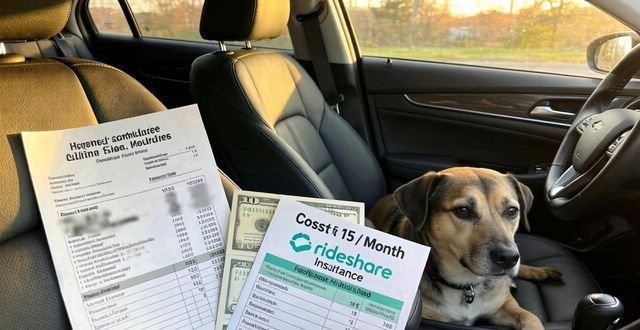
Look at the math from a distance. An at-fault accident without coverage means you pay for the other car, the other driver’s medical bills, your own repairs, and any lawsuits. That’s easily $50,000 to $200,000. A rideshare endorsement costs about fifteen to thirty extra dollars per month. Which one sounds like a trap? Which one sounds like a plan?
I did not add that endorsement before my accident. I paid out of pocket – two thousand for the pole damage, plus six hundred for the dog’s stress-related vet visit (he started shaking after the impact, poor guy). And I was lucky. No one got hurt. No other car. But the fear that ran through me when the adjuster said “denied” – that cold wave from chest to fingertips – I would not wish it on anyone. So now I talk about it. Not to scare you into buying something, but to scare you into checking your own declarations page tonight.
Take out your phone. Open your insurance app or dig up that PDF. Search for the word “rideshare” or “transportation network.” If you see an exclusion and no endorsement, you are driving naked every time your app goes dark. And here’s the kicker: even if you never have an accident while off the clock, a simple traffic stop for a broken taillight can lead to a cop asking, “Do you do Uber?” If you say yes, that goes into the report. Your insurer runs periodic checks. They can cancel your policy mid-term for material misrepresentation. Then you’re really stuck.
So what’s the one move you make tomorrow? Call your agent. Not email. Call. Ask directly: “Does my policy cover me when my rideshare app is completely closed?” If they hesitate, hang up and call a different insurer that offers the endorsement. Progressive, Allstate, GEICO, State Farm – they all have versions of it in most states. Do not accept “we’ll add a commercial policy for $400 a month.” No. You want the personal policy with the rideshare gap filler. It exists. It’s affordable. And it turns that terrifying “app off = no coverage” equation into a solved problem.
You cannot control the other drivers. You cannot control the weather or the deer that jumps out at 11 p.m. But you can control whether your insurance follows you when you’re just trying to get home, buy milk, or take your dog to his follow-up appointment. Do not learn this lesson like I did – on a Tuesday, in a parking lot, with a shaking dog and a denied claim. Turn off the app. Keep the coverage on.